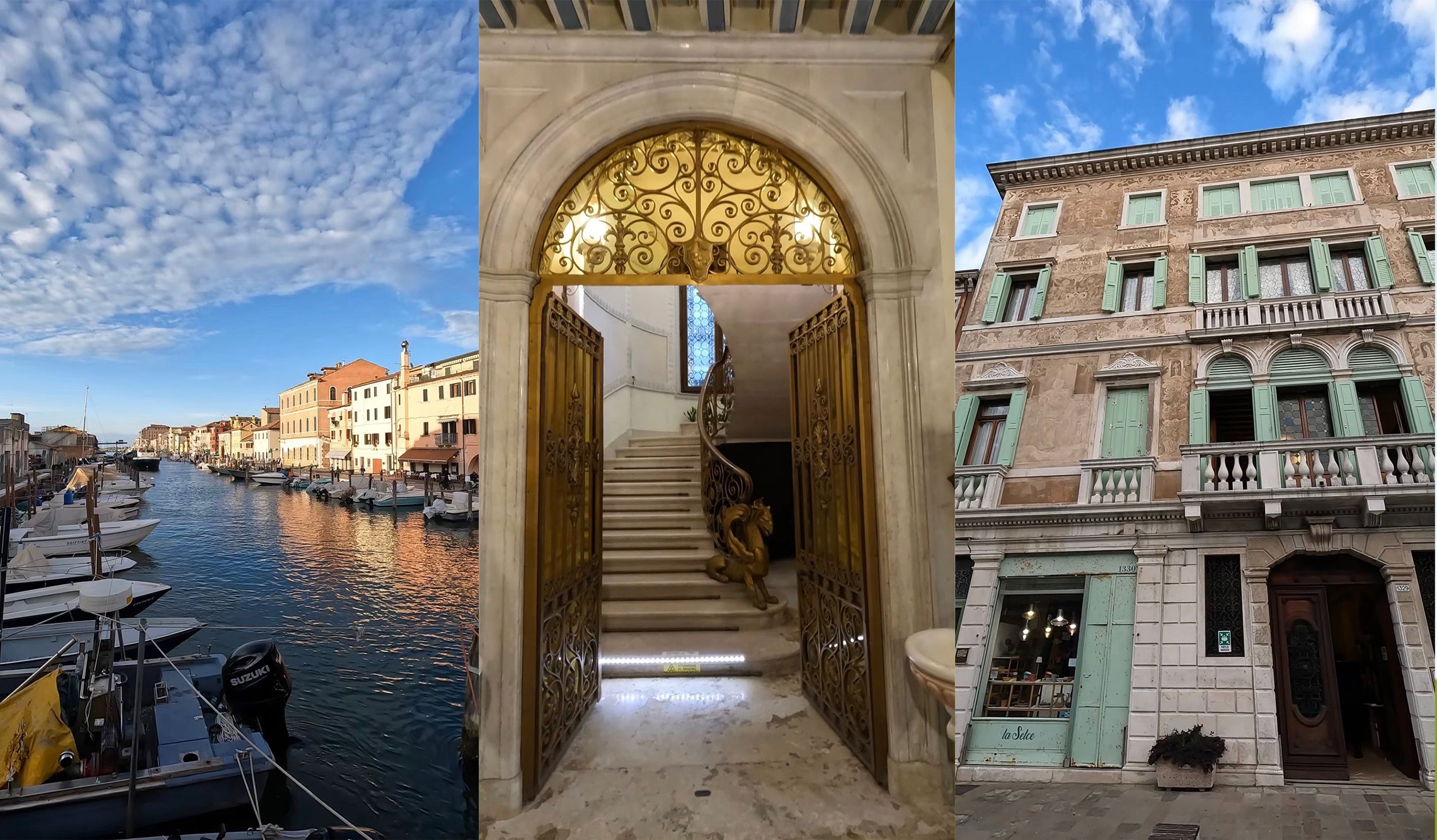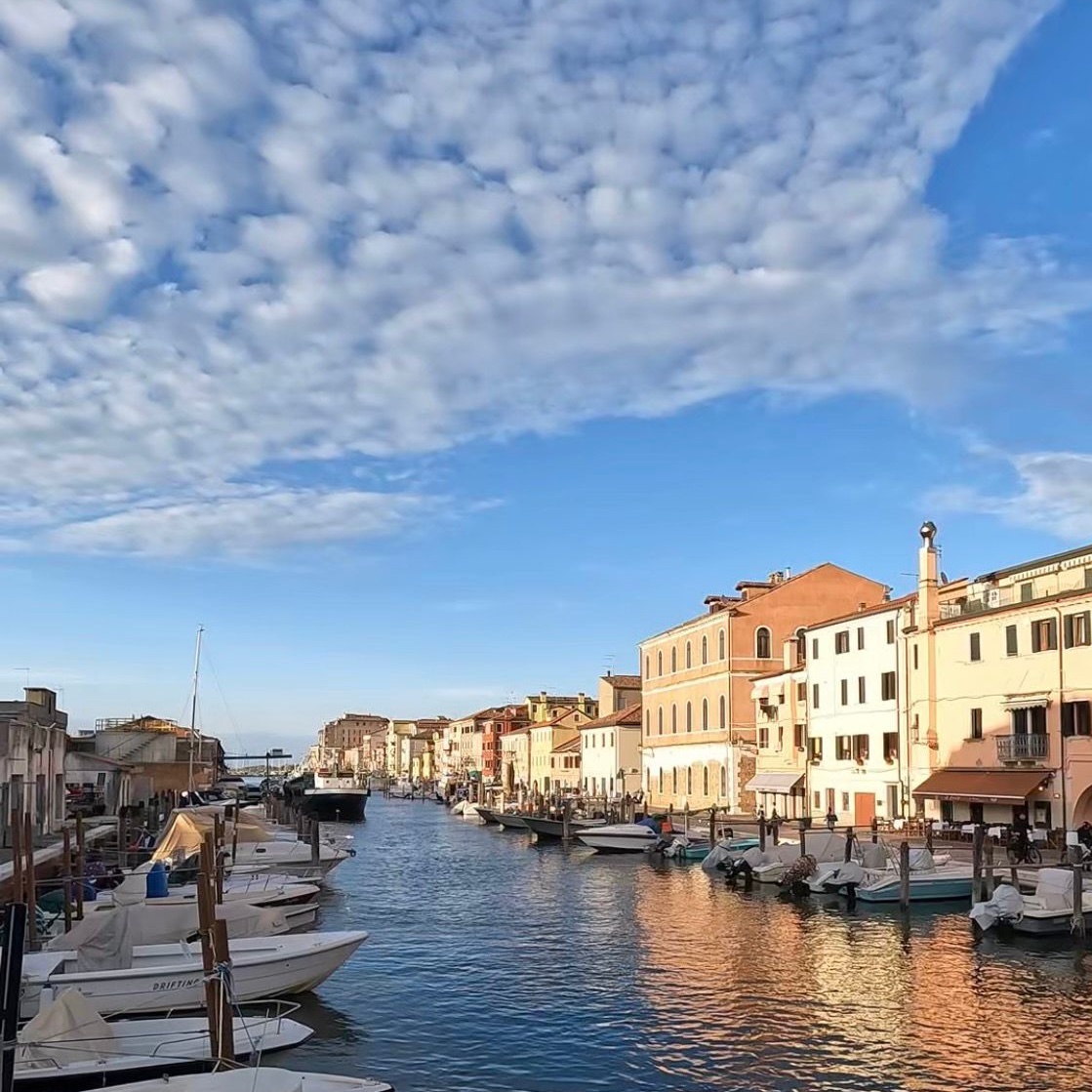
At the confluence of three wondrous bodies of water—the Venetian Lagoon, the Adriatic Sea, and the mouth of the Adige River—Chioggia was born, a city of unhurried and joyful life. Here, the meeting of cultures and the artistic expression of centuries of history are reflected in a palace steeped in history and beauty: the Brusomini Naccari Palace.
It was the Age of Enlightenment, the 1700s, and the city, despite the precariousness of most of its population, was undergoing a radical transformation in architectural and urban planning. A typically 18th-century building was born, with an internal courtyard, a central well, an elegant internal spiral staircase, frescoes, interior decoration, and a façade adorned with floral motifs and symbolic figures.
Apparently, according to the Napoleonic land registry, it was built during the French occupation. At that time, it belonged to the Brussomini family. When Brussomini’s widow married Antonio Naccari, the palace acquired the double surname. While owned by Antonio Naccari, who was the “podestà” (administrative and judicial authority from the Middle Ages until the Fascist period), a historic event took place within the palace that changed the life of Chioggia and Italy itself.
It was the second Austrian occupation of Chioggia, and the famous “Insurrection of 1848” against the Habsburg government had erupted throughout the Province of Venice. A great bloodbath was anticipated.
In my opinion, unlike our current wars, which erupt rapidly and result in the rapid deaths of many people, but which are slowly resolved or ultimately never resolved at all; history offers us surprising facts:
The commander of the Austrian Army met with the Chioggia civic guard in the main hall of the Palazzo. In the presence of Regent Antonio Naccari, the Austrian Commander and Baron Giuseppe Gorizzutti signed the surrender, handing over the government to Naccari. The palace passed to his successor, Count Achiles Brusomini Naccari. After Achiles’ death, in 1909 it was purchased for 70,000 lire (equivalent to €36.15 today) by Piero Ravagnan. Currently, the palace belongs to two families, the Batello and the Gomiero.
I had the opportunity to exhibit my works in this palace and tour it in the company of Umberto Batello, one of its owners. The beauty of its rooms, on par with the grand palaces of Venice, is beyond description, but what I remember most and what has left a lasting impression on me are the two inscriptions amidst the bucolic and seemingly banal decoration of the façade:
LABOR OMNIA VINCIT and PRECLAROS CONSTANCIA NUTRIT.
Virgil, in the four books of the Georgiche, left us with these words:
HARD WORK CONQUERS ALL DIFFICULTY.
CONSTANCY NOURISHES THOSE WHO STRIVE FOR FAME.
The Palace gave me this realization: I’m creating something that makes me happy. I don’t consider it hard work; I have plenty of constancy and I’m not seeking fame. I want to make a living from it and offer others the enjoyment of the results of this work.